Monday, April 11, 2011

FDR's New Deal


The First New Deal

I)       Poor People’s Campaigns
A)    Communist Party and Unemployed Council – led the agitation for rent relief and anti-eviction actions, as well as for direct relief, in many large cities.  The Communist Party was not the only left-wing political party active in this type of activity, however; the Socialist Party was active, as well as the American Workers’ Party, led by A.J. Muste (a former minister)

1)      Sharecroppers’ Union – active in Alabama, helping croppers fight for their rights; one such organizer, named Angelo Herndon, was charged and convicted of inciting insurrection in the States

2)      Scottsboro – role of Communist Party in publicizing this miscarriage of justice, as well as paying for the defense of the Scottsboro Seven (or the Scottsboro Boys, as they were popularly known at the time), increased the popularity of the party in the African American community.

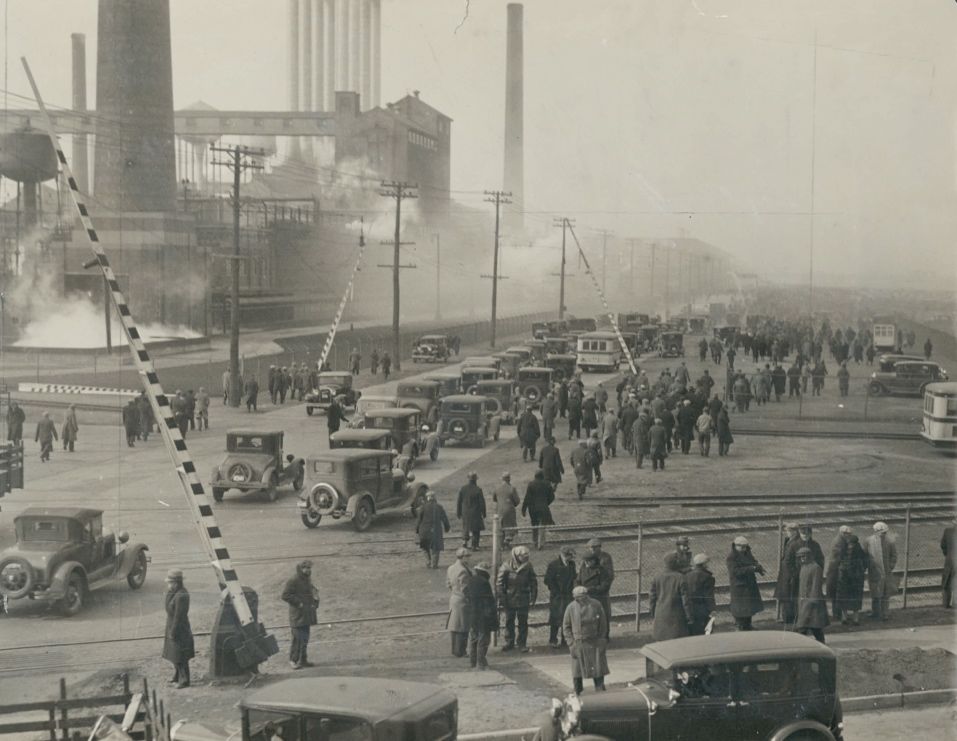
3)      Ford Hunger March – from Detroit to River Rouge plant in Dearborn; Ford shutdown had forced more than 60,000 people onto relief rolls in Detroit.  A crowd of about 3,000 people marched, and were met with tear gas, fire hoses (in sub-zero weather), and bullets from the Dearborn police and the Ford Service Bureau thugs.  Four people were killed and more then 60 were injured; the funeral procession attracted 20,000 marchers while thousands more observed.

B)     Bonus Marchers – Congress had promised each veteran of WWI a bonus to be paid in 1945; 20,000 were soon camped out on the Mall to urge an immediate payment, which the House passed by the Senate did not.  In July, the Hoover administration decided to evict the protestors, which McArthur did with tanks, tear gas, and bullets.  Most American people were repelled by this action when they saw it on newsreels, and even more so when Hoover defended this action.

II)     1932 Presidential Election

A)    Hoover’s popularity – Hoover, of course, was hugely unpopular; most of the blame and frustration with the economic woes most people were facing were placed upon him.

B)     Franklin Delano Roosevelt – promised to balance the federal budget (Hoover was running the largest peace-time budget deficit in the country’s history at this time) and trim the federal payroll; his stand on religion and drink were completely unexamined during the campaign (much to his benefit).  Roosevelt campaigned on the slogan “A New Deal for the American People.”

1)      Background – patrician (meaning he came from old money, as did his cousin TR).  In many ways, he tried to model his political career with that of his cousin’s—he served as New York assemblyman, secretary of the Navy, and he was the Democratic Party’s choice to run as Vice-President in 1920.  In 1921 he was stricken with polio, and was never able to walk without some kind of assistance after that.  That he was able to make a political comeback from this disease was due in large part to the assistance of his wife, his second cousin Eleanor.

2)      FDR won 57% of the popular vote (against an immensely unpopular Republican candidate); the only state that he lost outside of New England was Pennsylvania.

III)  First 100 Days – this has often been treated by historians as the implementation of the Roosevelt “plan;” however, Roosevelt operated during this time period without any plan, and often under conflicting advice from his advisors.  Most of the actions taken during these 100 days were forced upon the administration by events.

A)    March 1933 Bank Holiday – the first action that Roosevelt took during his administration was to order all banks closed to prevent a “run.”  Banks were allowed to reopen when they were able to prove that they were solvent.  While this sounds like a very drastic measure, it should be pointed out that 36 states had already closed the banks they chartered (and at this time there were only 48 states). This caused some temporary hardships, but as banks reopened they did so with the assurance that they were solvent—and thanks to the insistence of Michigan Republican Arthur H. Vandenberg, the federal government now protected bank deposits up to $2,500 through the predecessor of the Federal Deposit Insurance Corporation (FDIC).

B)     Fireside Chats – FDR became the first president to regularly use the radio to communicate with the American people.  FDR used a friendly, conversational tone on the radio, and many people came to look upon the president as a personal friend, someone who was interested in their welfare.  Because he also came to embody the government, many people came to see the government as directly interested in their welfare, as well.

C)     “Alphabet Agencies” – these agencies were populated with young Jewish and Catholic intellectuals, who were largely unwelcome in the Protestant-dominated business world.

1)      Federal Emergency Relief Administration (FERA) – the agency charged with providing funds for the unemployed.  Although the agency did hand out direct relief, much of the relief that people received they had to work for.

2)      Civilian Conservation Corps (CCC) – largely served young adult males; moved city boys into the country (away from those corrupting influences) to work on conservation projects.

3)      Civil Works Administration (CWA) – small scale public works projects, mainly road-building.

4)      Agricultural Adjustment Administration (AAA) – implemented a whole series of laws and policies to assist farmers; restored “parity”; government made payments to farmers for NOT planting crops, which acted to decrease the supply and force prices upward.  The timing of the implementation of this piece of legislation meant that many farmers had to destroy crops that were already planted as well as livestock.

(a)    Who benefited? – most of the benefit of these policies went to larger and corporate farmers, who could take more land out of cultivation

(i)     Southern Tenant Farmer’s Union – formed to protest this development; it was a bi-racial group, which of course was threatening to those in power in the South, and therefore was swiftly and violently put down (evictions, and attacks on road side camps)

5)      Public Works Administration (PWA) – funded larger building projects, like University Hall and the Glass Bowl, as well as much of the expansion of the Toledo Zoo, and eventually a new public library.

6)      Tennessee Valley Authority (TVA) – provided flood control for the Tennessee Valley (the Tennessee River flows northward from Alabama, through Tennessee and Kentucky to the Ohio River); the dams for this flood control also brought cheap electricity, which attracted industrial development in the area as well.

7)      National Recovery Agency (NRA) – perhaps the most famous of the alphabet agencies was the NRA. What the NRA proposed to do was to foment the development of cartels in the US economy—that is, to encourage the formation of monopolies. It was thought at the time that this would help stifle cut-throat competition, because companies would be allowed to collude together to fix prices and divide the market between themselves.

(a)    Section 7a – in return for being allowed to form cartels, businesses were to allow employees to join unions “of their own choosing.” This section was ambiguous on the point of whether these had to be independent unions, or whether they could be company unions. United Mine Workers president, however, sent organizers into the field with the message that “The President wants you to join the union.”

(b)   The NRA was overturned by the Supreme Court, and was the impetus for Roosevelt’s attempt to “pack” the Supreme Court (which had to this point blocked much of the New Deal legislation).

(c)    The NRA, headed by the mercurial (and possibly unstable) Gen. Hugh Johnson, had largely failed before it was killed by the Supreme Court. Compliance to the NRA codes was largely voluntary, and therefore businesses often failed to comply. Additionally, the union provision proved unsatisfactory to both businesses (who were, for the most part, extremely reluctant to work with labor unions) and labor (who were disappointed that Section 7a allowed the creation of company unions to compete with them).

The Second New Deal

I)       Works Projects (Progress) Administration (WPA) 1935-1942

A)    Productive jobs – WPA employees saw themselves as workers and citizens, not welfare cases; workers received nearly double to rate of pay of workers on earlier programs (although, at FDR’s insistence, still below the rate of the private sector, so that no one would be tempted to live on government largess), and they were exchanging their labor for money, just as they had during their employment in the private sector

B)    8,000,000 people put to work during the life of the life of the program

1)      Toledo – Anthony Wayne Trail, Toledo Zoo

2)      Cleveland – numerous bridges, Memorial Stadium

3)      The Ohio State guide series

C)    Popular Culture and the New Deal

1)      Art

(a)    Murals – numerous murals were painted in public buildings, inspired by Mexican muralists like Diego Rivera and Jose Clemente Orozco (local examples include the Perrysburg Post Office and various buildings at the Toledo Zoo).

2)      Federal Writers Project

(a)    State guides – government funded “guides” were produced for each of the 48 states; larger cities also got their own guides.

(b)   Slave narratives

(c)    Narratives of immigrants and cowboys, as well

3)      Federal Music Project

(a)    Created 34 symphony orchestras

(b)   Sponsored numerous dance bands

(c)    Collection of folk music (Alan Lomax)

4)      Federal Theater Project – perhaps the most controversial of the federal projects

(a)    Living newspaper – writers and actors collaborating to produce drama out of recent news, and dramatizing current events.

(b)   Ethnic theater groups – Yiddish, Spanish language.

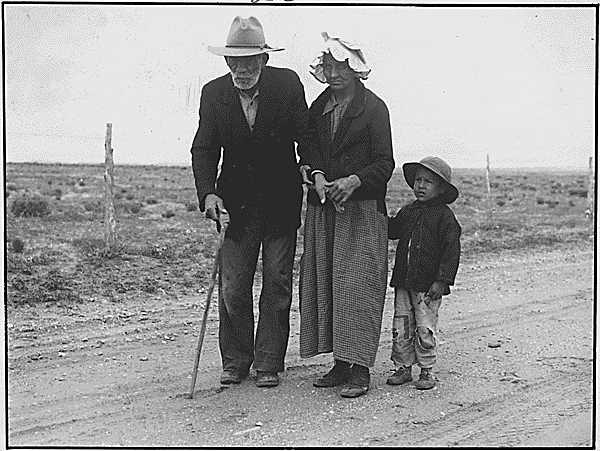
5)      Photography – not strictly WPA; photographers were also hired by the Department of Agriculture, and particularly the Farm Security Administration.  The photographers often were able to publish their photographs in popular magazines of the day.  When viewing these photographs today, one should keep in mind that these photographers were hired to take photographs by government agencies, in the expectation that these materials would help the government build its case for specific government programs.

6)      Cultural forces outside of government

(a)    Woody Guthrie

(b)   John Steinbeck – Grapes of Wrath and Of Mice and Men

(c)    Warner Brothers Studio – the unofficial house studio of the New Deal; Jack Warner was FDR’s main supporter in Hollywood, outside of the acting and production talent.

7)      Screen Actors Guild – although established earlier, the Screen Actors Guild becomes more of a force to be reckoned with during this time period (in fact, a second banana actor named Ronald Reagan begins a second career when he rises to the presidency of the organization in the 1950s).

II)    Social Security Act (1935) – now synomomous with an old age pension, the program encompassed much more than this at its inception; it was an attempt to build a European-style welfare state, with cradle-to-grave coverage.

A)    Help for the elderly

1)      Immediate aid – a whopping $15 a month

2)      Federal pension financed by payroll tax split evenly between workers and employers

B)    Unemployment insurance – administered at the state level, which meant that compensation was higher in the north than in the south; the program was meant to counteract the insecurity caused working families caused by temporary layoffs.

C)    Political, rather than fiscal, issue – because the program was supported by a tax paid by workers and employers (for whom the workers produced a profit), workers felt that they had “earned” benefits, which made it appear to them (and some of the more conservative elected officials who represented them).

D)    Aid to Dependent Children – granted on a monthly basis, after a social worker visited the family to ascertain their needs.

E)     Racial Inequalities – as the potential for more non-whites began to receive these benefits, the benefits became more controversial.

1)      Racial code of the Social Security Act – the act excluded, at the insistence of Southern legislators, agricultural workers and domestic servants—or about 60% of the African American workforce.

2)      Sharecroppers and farm laborers – excluded from benefiting from unemployment insurance, as well

3)      Disparities in Aid to Dependent Children – families in Arkansas received approximately 1/8 of the total aid given to families in Massachusetts

F)     Fair Labor Standards Act – ended ½ day on Saturdays as a usual workday, and made the 40-hour week standard nation wide; the FLSA also pegged the minimum wage to Southern wages of textile and lumber workers, in the hopes of eventually raising those rates.

G)    Wagner Act – officially known as the National Labor Relations Act, but named for its Senate sponsor, Robert Wagner of New York.

1)      Hoped to answer two problems

(a)    Industrial unrest and social turmoil – as was seen in the labor actions in 1934

(b)   Wage stagnation and under consumption – these two problems were seen by an increasing number of people in the New Deal as the reason for the Depressions grip on the economy of the country.

III) Rise of the CIO – initially these letters stood for the Committee for Industrial Organization; after the break away from the AFL, the organization became known as the Congress of Industrial Organizations.

A)    Formed in the fall of 1935 – by unionists inside the AFL who believed that unions had to begin organizing workers by industry to begin combating the economic clout of large corporations.

1)      John L. Lewis – president of the UMW; to this point Lewis was an autocratic leader (and he remained that in the UMW).  Lewis’ change of heart was probably dictated by his unions inability to organize “captive” mines—that is, the mines owned by the steel companies

(a)    Communist organizers – Lewis utilized numerous Communist and Socialist organizers in his drive, mainly because of their superior organizing results.  When asked if he were concerned that these organizers might persuade workers to join these other organization, Lewis replied, “Who gets the pheasant, the dog or the hunter?”

B)    Flint Sit-Down Strike (1936-1937) – in many ways, this strike was the defining moment for the early CIO, and certainly for the fledgling United Automobile Workers (UAW).

1)      GM employed 80% of the Flint workforce at this time, either directly or indirectly, so the economic impact of the company on the community was huge, and the corporation could usually rely upon city government to be compliant with their wishes.

2)      GM workers began strikes around the country in November and December of 1936.

(a)    Toledo GM workers – had successfully struck the Chevrolet Transmission plant on Central Avenue in the spring of 1935, with hardly any violence; many Toledo union members had advocated asking other GM workers to go out on strike as well—in fact, a caravan drove to Flint.  The AFL representative actively discouraged this action, however.  The corporation responded by pulling out half the machinery in the plant over a Thanksgiving lay over, with a resultant loss in jobs.

(b)   UAW plan – the leadership of the union planned to strike Fisher Body plants in Cleveland and Flint after the start of the year, when workers received a bonus from the corporation, and more labor-friendly administrations took office in Ohio and Michigan

3)      The Sit-Down Strike – this tactic allowed a militant minority to shape events; by occupying the building, workers were able to ensure that their would be no scab replacements—and that the threat of attacks on the workers would be minimized because they were inside with all of the expensive machinery

(a)    First utilized in Akron – this tactic was first used by tire workers in Akron, even if Flint workers get most of the credit

(b)   Battle of Bulls Run (January 11, 1937)

(c)    Workers seizure of Chevrolet Plant #2 forced GM to bargaining table.

IV) Presidential politics

A)    1936 Presidential election

1)      Roosevelt Landslide – Roosevelt used a great deal of populist rhetoric in the election, calling the Republican Party “economic royalists” and “organized money.”

2)      Roosevelt won 60% of the popular votes cast (greater than his victory over Hoover), and the electoral votes of every state except Maine and Vermont.

(a)    African American vote – by 1936, African Americans voted overwhelmingly in favor of FDR over the Republican standard-bearer, in a reversal over long-standing tendencies to vote for the party of Lincoln.  This occurs, despite some discriminatory practices in New Deal programs, for several reasons.

(i)     “Black Cabinet” – second level bureaucrats and black leaders outside of the administration who provided advice to the administration; these African Americans were particularly influential upon Eleanor Roosevelt.

(ii)   Eleanor Roosevelt – when African American singer Marion Anderson was refused the use of the DAR Hall in DC to hold a concert, Eleanor R. resigned her membership in the organization, and arranged for Ms. Anderson to give her concert on the Mall, on the steps of the Lincoln Memorial.
B)    Roosevelt Recession – FDR’s lack of ideology comes back to haunt him; because he was not a true believer in Keynesian economics (explain Keynesian economics), Roosevelt was never comfortable with the sizable deficit that his government was running; with his sizable victory in 1936, he decided to greatly reduce spending in 1937, with disastrous results.

1)      Economic recession – the Roosevelt Recession probably contributed most to the disenchantment towards Roosevelt, and the gains by conservatives in the elections in 1938.

2)      Political backlash

(a)    Reaction to “packing” the Supreme Court – a reactionary court had ruled against Roosevelt policies in numerous cases to this point; FDR advocated being enabled to nominate an additional justice for each one over the age of seventy-five (which would have added four additional justices to the bench); both Republican and many Democrats claimed Roosevelt was attempting to become dictator. The public fallout here was probably less severe than the bad press this generated for the President.

3)      Backlash against labor

(a)    Monroe MI – Republic Steel private police force gassed SWOC headquarters and set fire to it.

(b)   Youngstown – Gov. Davey, who labor had supported in the 1936 election, read the handwriting on the wall, and used the National Guard to protect and escort strikebreakers to another Republic Steel plant on strike in this city.  Phil Murray, whom Lewis had appointed to head up the SWOC Little Steel organizing drive, called for FDR to assist in this crisis, which he refused to do; this was the beginning of the rift between Lewis and FDR.

                   (c) Chicago Memorial Day Massacre – Republic Steel employees in Chicago on strike were rallying when Chicago police opened fire on the unarmed crowd, killing several; newsreel footage of this incident was withheld because officials feared it would be incendiary

Wednesday, April 6, 2011

Assignment 12

For weekly assignment 12, read the excerpt from Robert S. and Helen M. Lynd's Middletown, found on pages 221-222 of your documents reader (or by clicking on the link above), and then answer the following question.

Cars, movies, and advertising--were the residents of Middletown right to feel uneasy about the changes in their community? Why or why not?

The Fall of Industrial Democracy--and the Rise of Consumer Culture


I)                   Industrial Democracy

A)     Definition – actually, there is no one definition of industrial democracy—it meant different things to different people.  To workers, it meant that they would have a say in how a factory or other kind of business would be run.  To owners of the factories and businesses, it meant that for the duration of the war they would tolerate government interference in the running of their business, in return for guaranteed profits—but only to the end of the war.

B)     Different views of Industrial democracy


1)      Americanization programs – largely under the control of the capitalist class, intended to make workers think and act like “Americans.”

(a)    Banishment of German language newspapers – distribution of German language material through the mail was banished in 1917, which effectively ended the large German press in the United States.

(b)   Company-sponsored programs


(i)                  Ford Motor Company – in the period just before the war, Ford introduced his famous “Five Dollars a Day” program, which he proposed to pay workers in his factories five dollars a day (about twice the then going rate for factory workers).  To qualify, workers had to pass inspection from the Ford Social Department, who ensured that workers were living frugally and would not dissipate the salary that they were to receive.  Immigrant workers, in addition to this, were also required to attend language classes if they did not speak English, and were lectured on work habits, personal hygiene, and table manners; they were also encouraged to move out of ethnic neighborhoods, and not to take in borders.

(c)    Loyalty organizations – groups like the American Protective League were formed by natives born to enforce their vision of Americanization upon the foreign born, as well as other natives who did not fit their vision of proper conduct.

(d)   Restrictions on immigration – although the numbers of immigrants was not restricted by law until 1924, and the effect of that law did not come into effect until 1929 (when, due to the world-wide depression, immigration would have fallen off, anyway), restrictions were placed upon immigration before that time period.


(i)                  Literacy test – immigrants had to prove that they could read and write in their native language—a law the AFL staunchly supported.  The law was passed by Congress over President Wilson’s veto

(e)    Eighteenth Amendment – the amendment abolishing the manufacture (except for personal consumption), distribution, and sale of any alcoholic beverage.   This concept had long been an aim of moralists in the country; what may have finally pushed the issue over the top was a backlash against the German American brewery owners who dominated the industry.

(f)     Nineteenth Amendment – giving women the right to vote; this was another long political struggle that reached fruition by the end of hostilities in Europe.  While this gave women the right to vote, most men who worked for passage did not expect this to change the political balance in the country, and it did not—the mostly middle class women who benefited most from this amendment voted in much the same way as the middle class men did.  Leading women who worked for passage of this amendment went immediately to work on passage of an Equal Rights Amendment, meant to remove the remaining inequalities between women and men; most were not around to see Congress finally approve it in 1972, and practically none around to see its failure to pass muster among the states.


2)      Industrial democracy for working people.

(a)    Labor as a partner in society – the symbolic importance of the positions that AFL president Samuel Gompers held should not be discounted in importance; this gave the working people that he represented (the single largest group, and growing during this time period) the impression that they finally had some influence in government.

(b)   Success of labor actions – with sympathetic members sitting on the War Labor Board, which was charged with adjudicating labor disputes, labor unions increasingly won recognition from companies, and modest wage increases for the workers they represented (which companies could afford to grant because many of them operated with “cost-plus” contracts from the Federal Government—which meant that the companies were guaranteed a certain level of profit).

II)                 Reaction to Industrial Democracy – after the signing of the Armistice, companies in the United States moved to rescind many of the agreements that had been reached during the war years.

A)    1919 Strike wave

1)      Seattle General Strike – a strike instigated by the International Associations of Machinists, who represented shipbuilding workers in the city.  Eventually, most workers in the city joined the machinists on strike, and a workers’ strike committee ended up running the city for three days—providing law enforcement, food distribution, and other essential services.

2)      Rossford Ford Plate Glass strike – led by the IWW, began the same time as the Willys-Overland strike; strike leaders were swiftly arrested, and carted off to Wood County county seat Bowling Green (with the assistance of a number of volunteer deputies recruited from the normal college there), where they were held largely incommunicado.  Catholic school children were told that there parents would be excommunicated from church if they attended a strike rally in Toledo; management in the factory armed and deputized by county; after several weeks, with the assistance of strikebreakers, strike defeated.

3)      Willys-Overland strike – Willys attempted to unilaterally impose a wage cut on workers; offered a profit-sharing scheme to workers, which was rejected.   When wage cut imposed anyway (in the form of a longer work day with no increase in wage), many workers walk off job at normal quitting time; workers are fired, and strike called.  Workers from Lagrange Street area board west-bound streetcars on Central, all workers who cannot produce a Chevrolet work badge are made to get off the streetcar.  Strikebreakers are hired, and housed within the company compound; strikers surround compound.  Sweeping injunction granted after North Carolina auto dealer claims business adversely effected.

4)      Steel strike – AFL made concerted attempt to organize steel workers during the war, and this attempt continued during period just after the war.  Most success occurred in the area around Chicago, and result encouraged attempts to organize workers in the Pittsburgh area.  Leadership of this drive was given to former Wobbly William Z. Foster, who had headed up a similar drive on the behalf of the Chicago Federation of Labor and the Amalgamated Meat Cutters and Butchers to organize packinghouse workers in Chicago area.  Steel companies refused to negotiate; used Foster’s syndicalist past to discredit him, and eventually crush the strike.

5)      Boston Police Strike – walkout of the Boston Police force led to widespread looting and general lawlessness; Governor of Massachusetts, Calvin Coolidge orders the firing of the entire police force, and mobilizes the state militia to police the city.  This strike, perhaps more than any of the other of the hundreds that occurred, scared those in power most.

B)     Reaction of governing elite

1)      Red Scare – led by US Attorney General (and Presidential wannabee) A. Mitchell Palmer, a nationwide coordinated attack against known and suspected radicals took place in early January 1920, when hundreds were arrested, with a suspension of the rights of habeous corpus; some of those arrested are deported on minor violations; some of those who were American citizens—like Big Bill Haywood—jumped bail and left the country (Haywood fled to the Soviet Union, and is buried in the wall of the Kremlin).

2)      Institution of the “American Plan” – this plan was part carrot, and part stick.  While unions were unwanted in the workplace, in many factories the indiscriminate powers of the foreman were curtailed, and powers to hire and fire were given instead to newly instituted personnel departments.

(a)    Power of foremen curtailed
(b)   Institution of personnel departments
(c)    Grievance procedures
(d)   Profit-sharing and stock options plans
(e)    No collective bargaining, however

I)                   Mass Culture

A)    Radio – for the first time, a mass audience could experience an event at the same time.  Although this was used as a technique to keep alive ethnic cultures (polka stations, foreign language programs, etc.), it also allowed others outside that culture to experience it; business side led to mass entertainment to sell products—which in turn contributed to the homogenization of culture

B)     Phonograph records – a way to maintain ethnic ties as well; but once a record was distributed, there was no way to limit who would consume it, which meant that there was a great deal of interaction between cultures, which in turn created a new culture (Caruso, Sophie Tucker “The Last of the Red Hot Mamas,” the Austin High Gang of ethnics who frequented the jazz clubs of Chicago’s South Side and helped to create the swing music of the 1930s, particularly one Benny Goodman)


C)    Movies – 1920s were a boom time of the downtown movie palaces, which were paeans to consumer culture; as the star system became more refined, these actors became more and more used to sell products (cigarettes, automobiles, etc.)

D)    Automobiles – by 1929, 50% of American families owned an automobile, and the industry directly employed 375,000 people—with millions more indirectly employed because of it.


1)      Fordism – Ford’s contribution to the automotive industry was his drive to reduce the cost of the automobile, so that it would become more widely accessible to the general public; Ford accomplished this by increasing the number of specialized machines used to create parts for the automobile.  This had two advantages: it decreased his reliance upon skilled workers, who could demand higher wages; and it allowed him to set a specific pace of manufacturing, rather than letting the workers set their own pace

(a)    Model T – extremely limited choice (it came with no options, and in one color—black), but this allowed Ford to perfect its manufacture—which in turn allowed Ford to drop the price of the automobile from $950 when it was introduced in 1909 to $290 at the height of its popularity in 1924

(b)   $5 a Day – the famous $5/day wage, instituted in 1914, was approached by few workers, but it helped limit the turnover of 300%; the higher overall wage also allowed workers to purchase the product that they were manufacturing (analogy to Bush directives for Americans to do their “patriotic duty” and purchase stuff in reaction to Sept. 11)

(c)    Increased mobility – ownership of an automobile allowed many more people to move to the suburbs (or “into the country’); also created a greater demand for recreation—along with more workers employed in routinized labor.


2)      Sloanism – named after the President of the General Motors Corporation, Alfred P. Sloan.  Sloanism is in many ways the perfection of Fordism; automobiles were provided in a variety of styles (kind of), and a variety of price ranges

(a)    Creation of the General Motors Acceptance Corporation – GMAC created in order to provide financing for potential automobile purchasers who could not pay cash for an automobile.

(b)   Triumph of Sloanism – by 1927, falling sales of the Model T forces Ford to shut down production, and re-tool for the production of the Model A.  In 1924, Ford had commanded 55% of the new car market.

(c)    Increased importance of advertising – used to help people differentiate between largely undifferentiated products; advertising allowed companies to manufacture desires in their customers.

E) Sports--the 1920s were the "golden age" of sports.

1. Baseball--Babe Ruth was traded from the Boston Red Sox to the New York Yankees after the 1919 season, and became an everyday player instead of one of the best left-handed pitchers in baseball. The manufacture of the baseball itself was refined and made easier to hit fan-pleasing home runs--deemed a necessity after the so-called Black Sox Scandal, where members of the Chicago White Sox team were accused of "throwing" the World Series to make money for gamblers--to make up for the shortfall many players felt because they felt the owner of their team was less than generous with them.

2. College football--dominate teams developed in the Midwest during the 1920s, with the play of Harold "Red" Grange at Illinois and Bronko Nagurski at Minnesota joining the still formidable teams at Michigan and the University of Chicago.

3. Boxing--the "Roaring 20s" got their start here in Toledo in 1919, with the Jess Willard/Jack Dempsey prize fight that took place in Bay View Park. Willard defeated the champion Jack Johnson--the first African American to hold the heavyweight title—in 1915. Willard fought a series of white stiffs before being viciously pummeled by Dempsey and defeated in Toledo.


II)                 African American Culture and Political Development in the North – the vitality and creativeness of African American culture first gets widespread recognition as more African Americans move north, and more white northerners come into contact with it.

A)    Jazz – first comes north in the early 1920s—moved up the Mississippi from New Orleans to St. Louis, and then from St. Louis to Chicago; Louis Armstrong moved to Chicago from New Orleans, first with his Hot Five (which eventually grew into his Hot Seven).

1)      Southside Chicago – the area around 43rd and State was the heart of the African American community in Chicago, the so-called Black Metropolis.  It was here that a group of second generation ethnics from the west side Austin High School came to listen to the jazz bands that played the venues here, and by the late 1930s had transformed the sound into what we know as swing.

2)      New York – NYC quickly became a Mecca for African American jazz players, who found gigs in the burgeoning African American neighborhood in the city known as Harlem.

(a)    “Black and Tan Clubs” – clubs where “slumming” whites could come and listen to and dance to black combos, without having to be alarmed with having to mingle with too many African Americans, unless it was the wait staff or the musicians.  The Cotton Club became the most famous of the clubs.

3)      “Sweet” music and “hot” music – white dance bands toured the hinterlands playing “sweetened” versions of new “hot” jazz hits.  Bands like the Paul Whiteman Orchestra, who would hire a few “hot” players (most notably Bix Biederbecke), but played mainly toned down versions of jazz music.
III)              Reaction to Mass Culture

A)    Prohibition – outlawed the manufacture, and legal drinking; led to the flowering of organized crime.  By outlawing what had been acceptable, it grouped this behavior with other behavior that was looked down upon as well (secular music, dance, homosexuality) that then became tolerated in this developing underground society—and then more laws were passed to outlaw this behavior.

B)     Rise of Fundamentalist Religion – reaction to increased urbanization, increased social contact with Catholics and Jews in urban settings.  White southerners moving north also contributed to this.  Billy Sunday and Aimee Semple McPherson

C)    Rebirth of the KKK – became particularly active in northern cities (as well as much of the state government in Indiana); Catholics and Jews became as much a target of intimidation in the North as African Americans during this time. 

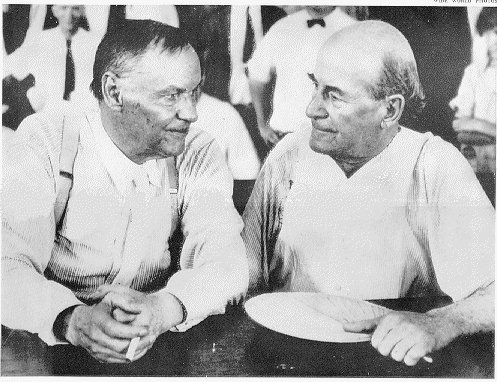
 D) Scopes “Monkey Trial” – in Dayton, TN, ACLU convinced a teacher named John Scopes to violate recently passed creationist law; Clarence Darrow was the lawyer for the defense, and William Jennings Bryan was on prosecution team; Darrow called Bryan as an expert witness, and got him to admit to numerous embarrassing literal interpretations of the Bible—Bryan died soon afterward.

Monday, April 4, 2011

Capitalism and the White Man’s Burden


I)                   Pullman

A)    George Pullman – made his fortune hauling Chicago out of the muck; after the Great Fire of 1871, efforts were made to raise the remaining buildings as much of the swamp that the city was built on was filled. Pullman used this money to establish a company to build sleeping cars used on long trips by railroad companies.

B)     Town of Pullman – as the company grew, Pullman became concerned about the effect the radicals in Chicago were having upon his workers, so several miles south of the city he built a town (housing, stores, public buildings, a hotel he named after his daughter Florence, even churches) which he rented to workers, but which he retained title.

1)      “Model” town – Pullman the town was a great example of welfare capitalism—that is, subsidizing certain amenities for workers so they remain satisfied on the job.

2)      Depression of 1893 – the economic depression of 1893 cut deeply into the profits of the Pullman Company, and Pullman responded by cutting wages and laying off workers, as any good capitalist would do.

(a)    Pullman rents – Pullman refused to cut rents in the same manner, however, since that division of the business had to show a profit as well.

(b)   Pullman workers respond by going on strike in the spring of 1894.

C)    Eugene V. Debs – a former officer of the Brotherhood of Railway Firemen, Debs in early 1894 became president of an early industrial union for railway workers, the American Railway Union

1)      Railway “Brotherhoods” – each specialty in the railroad industry had its own union, The Brotherhood of Railway Engineers, Brakemen, Conductors, Firemen; problems arose when railway companies settled with one of the brotherhoods, and they crossed the picket line while others were still on strike. The ARU is meant to be a solution to this problem.

2)      1894 ARU convention – was held in Chicago; a delegation of workers from Pullman, who plead for the assistance of the ARU. Despite Debs opposition, convention delegates vote to assist Pullman workers, and vote to boycott all trains with Pullman cars. Despite the fact that the ARU represents a relatively small number of workers, traffic all over the country is interrupted.

3)      Government response – because there was little violence accompanying the strike the federal government was hamstrung; with a sympathetic John Peter Altgeld as Illinois governor, there was little chance that federal aid would be requested.

(a)    Richard Olney – the AG for the federal government was a railroad attorney, and it was he who suggested attaching Pullman cars to mail trains (interfering with the mail is, of course, a federal offense).

(b)   Troops from Fort Sheridan (and the Dakotas) are called in “to keep the peace,” which allowed the strike to be broken.

(c)    Debs and other union leaders were arrested and held incommunicado, which also helped break the strike; Debs spent a year in jail in Woodstock, Illinois, which he spent reading socialist tracts; he becomes the Socialist Party candidate for president in 1900, 1904, 1908, and 1912, when he polled the largest number of votes to that time in history for a third party candidate.

II.  Roosevelt and Washington Politics

A. On the Stump for McKinley--whole Theodore Roosevelt has a well-deserved reputation as a reformer, he was first and foremost a Republican Party partisan, and willingly went out on the stump to prove it.


1.  William Jennings Bryan--gained the1896 Democratic Party nomination largely on the strength of his "Cross of Gold" speech (reproduced in the YouTube clip above). Although Roosevelt was closer to Bryan's position on a  number of issues than to McKinley, he played the good political soldier and went out to harrangue the crowds  about the danger of class  warfare that Bryan's election posed.

2. McKinley's fundraising--the fear that the specter of a Bryan election posed for the business interests in the country  posed made Mark Hanna's fundraising problem easily  overcome; the "businesman's tax" provided the McKinley campaign with more than $3 million, while Bryan's campaign could only raise $300,000. The election became a forgone conclusion.

B. Undersecretary of the Navy--as a political reward for his work  on the  McKinley campaign, Roosevelt was given the post of Undersecretary of the Navy.

1. Alfred Thayer Mahan--the leading naval theorist of his time, Mahan argued that a nation could only achieve foreign policy success by building a strong navy. To achieve this objective, the nation would also have to obtain places for its large fleet to refuel--"coaling stations"--with the reliance upon steam for locomotion. This became the one of the excuses for the aggressive imperialism that became manifested in the foreign policy of the United States in the years just before the turn of the century.

2. Imperialist foreign policy--in many ways, 1890 is a pivotal year. In that year, the  Census Department determined that the frontier in the United States had ceased to exist. By 1892, the historian Frederick Jackson Turner had developed  a theory that the frontier had been the determining factor in the development of democracy in the United States. That same  year, Homer Plessy was arrested in New Orleans for violating the new segregated railroad car law in Louisiana; by 1896, the Supreme Court would institute the doctrine of "separate but equal," instituting legal segregation. Worries about having room to expand met racist presumptions about the ability of  non-white peoples of the earth to govern themselves in this new imperialist foreign policy.

III. Cuba Libre!

A. The "Yellow" Press--the  birth of the modern newspaper in the years just before the turn of the 20th century led many of the papers to promote lurid, sensationalist stories in an attempt to sell more  newspapers.

1. William Randolph Hearst


B. Remember the Maine

1. The USS Maine--in response to perceived "Spanish aggression," the USS Maine was dispatched to Havana Harbor to "show the flag." On the night of February 15,1898 the Maine suffered a catastrophic explosion, which an investigating committee concluded could only have happened from a mine placed  in the harbor (modern evidence points to spontaneous combustion in a coal bin).  As a result, pressure to declare war on Spain grows irresistible. When McKinley asks Congress to declare war (the Constitutional method  of doing so, by the way), Roosevelt resigns his position in the administration to join the Rough Riders he had been busy organizing.

1. Cuban rebels--had been fighting Spanish forces off and on for the previous thirty years, and at this point had nearly worn Spain into submission before the Americans even began their short voyage. Rebel forces, in fact, held off Spanish forces during the American invasion, which is the main reason why the American forces landed unscathed.

C. The Rough Riders--is really a manifestation of the multi-culturalism that Roosevelt learned from his association with Jacob Riis. The Rough Riders were a mixture of blue blood friends from New York (who made up much of the officer corps), with cowboys, Indians, Mexicans, and a smattering of other  ethnic groups--with one important exception--who all brought the "barbarian virtues" that Roosevelt felt  Anglo-Saxons had lost.

C. The Charge up Kettle Hill--this engagement, like the whole War With Spain, was a FUBAR mess. It took weeks to transport troops to Cuba, supplies were inadequate--as were preparations, medical attention, and just about everything else  about the operation.

1. The Role of the10th Cavalry--under the command of General John J. Pershing, the all African American 10th Cavalry actually bore much of the brunt of the fighting for both Kettle Hill  and  San Juan Hill. Their bravery under fire was remarked on by a number of officers,  including initially one Lt. Colonel Theodore Roosevelt. The 10th Cavalry did not have a personal war correspondent,  however, so none of them were awarded a Medal of Honor


I)                   Mexican Revolution

A)    Border raids

1)      Two Mexican governments – one in the north (led by Poncho Villa), and one in the south

2)      Anti-American sentiment – many people in Mexico resented the United States interference in political affairs previously in Mexico, as well as the way many of their relatives and former countrymen were being treated in the Southwest.

3)      Unstable business environment – for US businesses, anyway; fear of intervention by British or German forces which would conflict with US business interests.

(a)    Petroleum

(b)   Mining – particularly silver, lead, and copper mines

B)     Intervention – invoking the Monroe Doctrine, used as justification to interfere in affairs of Mexico.

1)      Tampico Affair – avenging US honor, or the humiliation of Mexico?  US sailors arrested, then quickly released with apology from Mexican government; naval commander insists Mexican officials salute US flag, which they refuse to do; Marines and sailors occupy Veracruz by force.

2)      Pursuit of Poncho Villa – Villa, looking to provoke US invasion, Villa’s forces raid Columbus, New Mexico, burn it to the ground, and kill sixteen US citizens; Wilson responds by sending Gen. John Pershing into Mexico to pursue Villa; Pershing is unable to capture Villa or his forces, however, and US forces are withdrawn, quietly, a year later (to be transported across the Atlantic).

C)    “Dollar Diplomacy” – interventions on the part of US government to protect the interests of American businesses, began in 1909 with personal appeal from Taft to Chinese leaders on behalf of US businesses; with Wilson, this “diplomacy” often took the force of arms

1)      Nicaragua

2)      Haiti

3)      Dominican Republic

4)      Maj. Gen. Smedley D. Butler, USMC

II)                 War in Europe

A)    Hyphenated Americans

1)      German-Americans – number 8.25 million of German parentage

2)      Irish-Americans – 4.5 Million of Irish parentage

(a)    Both groups either expressed opposition for English war aims (Irish), or support for German war aims (German-Americans)

(b)   Why support Allies? – Cultural affinity with Great Britain by politicians; the fact that Great Britain controlled US access to information about the war, so US only heard about “Hun atrocities.”

B)     “Preparedness” v. anti-militarism – US had long held suspicion of large standing army, and of militarism, but this was in the process of changing.

1)      Preparedness advocates

(a)    Theodore Roosevelt – felt the military was the great democratic leveler (unless you were black and relegated to a segregated unit), and would restore masculinity that was sorely lacking, particularly in the middle class (desk jobs)

2)      Anti-militarists

(a)    William Jennings Bryan

(b)   Women’s Peace Party (40,000 members)

(c)    Most Progressives

(d)   Socialist Party

(e)    IWW – latter two believed that this was a capitalist war, fought to control overseas colonies (and largely, it was)

C. War and the National Interest--nations fight wars because they see  them serving  a particular national interest. Democracies must also convince their people that fighting a particular war is in their national interest

1. Convincing the American People--the Wilson administration had to put a great deal of effort to sell the war to the American people, both with propaganda and with severe punishment for speaking against the war effort.

a. Government propaganda--the US government had to sell the war to the people when the "preparedness" contingent became more vociferous after the sinking of the Lusitania and the loss of American lives.

b.German bumbling--Germany mad a series of rather bumbling attempts to keep the Unites States neutral or to at least keep the country from providing substantial aid to the Allies. These attempts ranged from the purchase of the New York World by German investors to aid the spread of German propaganda to the destruction of the Toms River Arsenal in New Jersey, which shattered windows in skyscrapers across the river in New York City. Espionage efforts by the German government were fairly easily uncovered by the US government, and eventually led to the largest portion of the American people supporting the war effort of the government.

2. Preparedness--a number of influential Americans--most prominently, Theodore Roosevelt--called for the United States' government to make greater efforts to prepare for the war than the government was then engaged in--or, indeed, than a majority of the people of the United States were willing to engage  in. Much of Roosevelt's frustration was the realization that what he advocated was profoundly out of step with what most Americans wanted--and Woodrow Wilson was in step with the desires.


D. Peace and the National Interest--many other Americans saw the threat of war being contrary to the national interest--particularly those Americans who would be asked to fight it.

1. Socialists--argued that the war in Europe was being fought to line the pockets of capitalists, and to further their economic interests. Socialists argued that instead, workers should refuse to kill other workers in this war.


a. Eugene Victor Debs--Debs had won over 900,000 votes in the presidential election in 1912, the most ever for the party to that time. Debs was an outspoken critic of the war, and continued to be so until he was arrested in Canton, Ohio for making the above speech.

b. Debs,  William D. Haywood, other socialist (and IWW members) were arrested, tried, and convicted of sedition--of speaking out against the war

E. Feminism and Peace--women were very involved in the peace movement;  many women (among them Jane Addams) argued that the role that women played in society--the nurturing mother--made women suited for maintaining peace in the world.

1. Rosika (Rosa) Schwimmer--Hungarian feminist and peace activist, who helped to found the Women's Peace Party with  Jane Addams. Schwimmer was able to persuade Henry Ford to put up the money to pull together the first international conference, where she proposed that the women offer their services for continuous arbitration.

2. Addams' Role--Jane Addams, because of her prominence in the American political scene, was elected to head up this new organization--a role that she was very good at, and a position that she held for most of the next two decades.

D. Why the Peace Movement Fails--the Peace Movement in the  United States failed because of the inept actions of the German government, the success of the British government propaganda, and the shift in support among the majority of American people

1. Government take action--the United States government, in response to the subtle shift in public opinion over the cause of war, passed repressive legislation to be used against those who spoke out against the war; indeed, the government quashed all dissident political movements, arresting and jailing members of these organizations. "Foreigners" were deported to their home countries, as a matter of fact.

F)    Wilson’s position – shifting, depending upon the political climate

1)      1915 – recommends military build-up

2)      1916 – switches positions, promising to keep US from entangling alliances, because that position is more politically popular, and there was an election coming up.

3)      Peace tied to US economic expansion--the United States manufacturing industries were able to sell much of their production to Europe, because of the strictures the state of was had placed on European manufacturers. In addition, US bankers became the financiers of the war effort in Europe, particularly for France and Great Britain, and their  financial interest would be best served by a victory by the Triple Entente.

G.    Economic Effects of War on US

1)      1914 recession – US securities were held abroad and cashed in for gold, which depleted reserves; between $2.5 and $6 billion worth of US securities were dumped in the fall of 1914.

2)      1915 boom – with orders for war materials from Europe, US business booming; also, with immigration from Europe cut off, workers seeing wages rise for first time after a series of recessions; however, wages do not keep pace with inflation which soon hits the economy.

(a)    Wall Street Journal – praised war’s “tendency toward conservatism” in financial matters.

H)     Effect of Total War in Europe on US

1)      British blockade – Most of German fleet was locked up in ports along the Baltic Sea due to British blockade and naval superiority.

(a)    Contraband – anything enroute to German ports was seized as contraband by British war ships, and transported to British ports.

2)      German U-Boats (Unterseebooten)

(a)    War ship inferiority – German navy smaller, had to rely upon U-Boats as equalizer.

(b)   SS Lusitania – British passenger liner, which German u-boat sank; suspected of ferrying small arms; of the 1200 passengers killed when it sank were 124 Americans (May 7, 1915)

(i)                  Bryan, greatest voice for peace in Administration, resigns post over Administration handling of Lusitania, which leaves hawks in control.

(ii)                Germany agrees to give warning to passenger boats in the future before torpedoing

(c)    German peace proposal – demands cessation of Belgium Congo, as well as other colonies; rejected by Allies.

I.     Russian Revolution (1917)

1)      Socialist revolution – overthrew czar, support for entering the war on the side of the Allies was gained from Russian Jews, Poles, and Scandinavian immigrants, who had feared policies of czarist policies.

2)      Allied war effort – in trouble; French leader Aristide Briand’s government falls; Britain forced to use conscription (and considers conscripting the Irish)

3)      Germany resumes unrestricted submarine warfare – in the spring of 1917

4)      Zimmerman telegram – Germany tries to make an allied pact with Mexico in case US should enter the war on the side of the Allies.