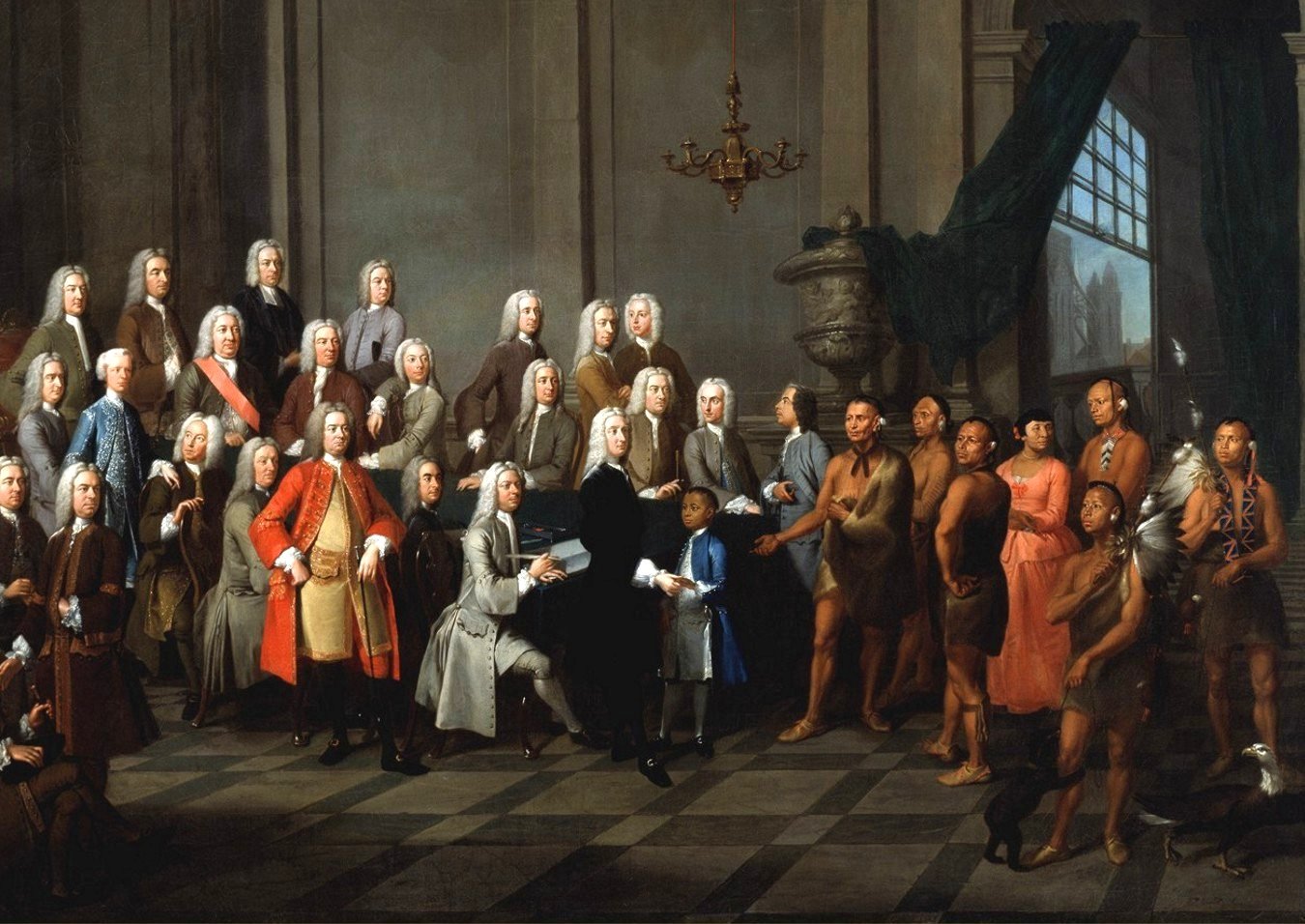
1.Common Cultural Trait Among Native Peoples--in North America was their conception that, as a people, they were granted the right to use the land that they occupied, but that individual members did not have any ownership rights to a particular plot of land. They were willing to share the land they had been granted with others, as long as they received “just” compensation for its use--and with the understanding that they could revoke the right to use the land at any time.
2.European cultural practice--on the other hand, Europeans utilized a different concept, which emphasized the rights of individuals to own a particular piece of land, with which they were allowed to use in anyway they chose--including selling it to someone else at a hefty profit.
a)Europeans also delighted in “sharp dealing,” meaning selling commodities at the highest possible price while buying commodities at the lowest possible price.
3.American Land Hunger—financial mobility for most whites living in British North American was reliant upon the availability of cheap land. Many of our sainted “Founding Fathers” were intimately tied up in a variety of land schemes, and large landowners looking to resell portions of the holdings to eager western pioneers.
a)Proclamation of 1763—the treaty that ended the French and Indian War (Seven Years’ War in Europe) did two things that angered many white colonialists in North America. It granted religious tolerance to Roman Catholics in Quebec, and it forbade further settlement by Europeans west of the Allegheny Mountains. This made economic advancement for the average American (as these people had begun referring to themselves) more difficult—and made the large landholdings of economic elites—people like George Washington and Thomas Jefferson—worth less.
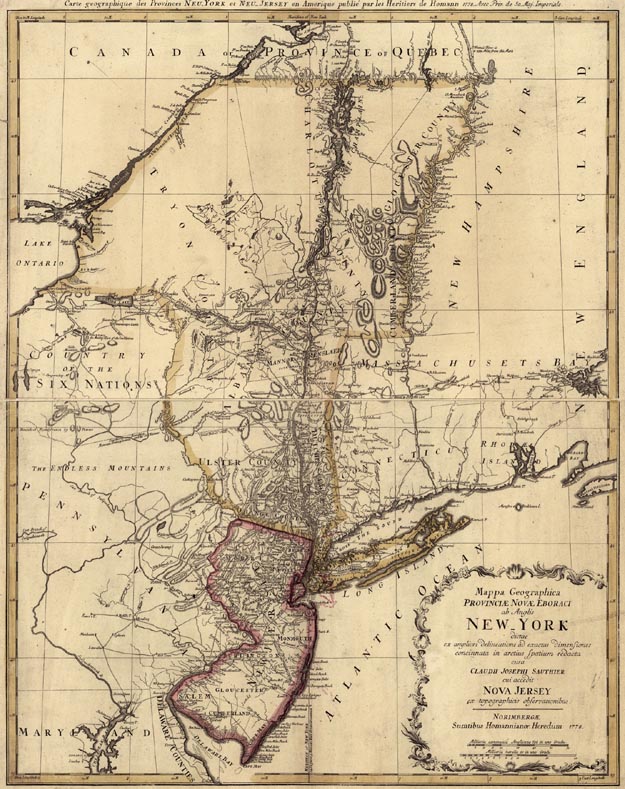
b)The Iroquois Covenant Chain—the Six Nations of the Iroquois (Seneca, Mohawk, Oneida, Cayuga, Onondaga, and the Tuscarora, after they left Virginia, acted as a buffer between the French on the northern side of the St. Lawrence River, in return for a variety of “gifts” from the Americans. This relationship changed with the end of the war, and the French ceding their claim to Canada and the lands north of the Ohio River
B. The Cost of the Conflict
1.The Frontier--is defined by the conflicts over possession of land between Europeans (or, as we might start calling them, whites) and native peoples. These conflicts necessitated that European powers found it necessary to have armies on the ground in the American colonies to keep the peace. All of this cost a great deal of money, and led to the European powers--England in particular--to seek ways of making the colonists bear a greater share of these costs.
2.Attempts to cut British costs--centered on limiting the contact between whites and native peoples by restricting the settlement of whites in frontier areas. The reason behind this was to cut costs for the British government, which could then hold the land at a lower cost, because fewer British troops would be need in the colonies if conflict between whites and Indians could be minimized.
3.Increasing tax revenue streams--the British government attempted to get American colonists to pay an increased share of the cost of maintaining the colonies’ administrative and military costs.
C. Colonial Resistance
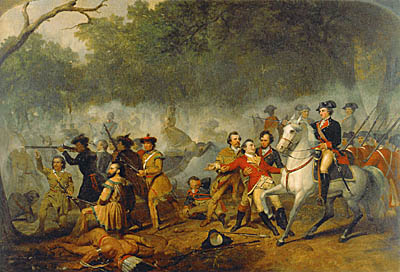
1.French and Indian War (Seven Year’s War)--ended in 1763, resulted in Great Britain obtaining European control of most of North American east of the Mississippi River. It was the attempt to administer this territory--and make it a paying proposition, particularly regarding the fur trade with native peoples--that led to a series of political moves that alienated the European population south of the St. Lawrence river, and led to the American Revolution.
2.North American smugglers--a number of merchants in North American circumvented restrictions on trading with non-English traders. Most of the taxes and duties passed by Parliament were attempts to enforce this restriction, but juries in the colonies refused to convict smugglers. Although smugglers usually had to charge higher prices for goods (ironically, the Tea Act actually slashed the price of East India tea, making it much cheaper than the tea John Hancock was smuggling into Boston Harbor0.
3.British Corruption—in the eyes of many colonists, the British government was corrupt, and its means of financing government expenditures spendthrift. The Bank of England (owned largely by men who grew rich from Caribbean sugar plantations) financed the debt by selling bonds (promises by the government to pay the value of the bond, plus interest, in the future—much the same way the US government finances its debt today, as does just about every other industrialized nation in the world). Which is not to argue that the British government was not corrupt, since it was. Most men protesting about the lack of representation in Parliament would not have been represented if they lived in England, either, since they would not have met property qualifications to vote.
a)John Wilkes—while he became a hero to many because of his defiance of George III, he was himself spectacularly corrupt and debauched, elected from a “rotten borough” who only posed as a friend of the downtrodden.
4.“No Taxation without Representation”
a)Sugar Act (1764)--like many of the laws passed during the decade leading up to the American Revolution, this law cut the tax rate, but also beefed up enforcement--and British sugar was more expensive than the which could be acquired from French plantations in Haiti.
b)Stamp Act (1765)--required the presence of a stamp from the government on any legal document--and also on newspapers, magazines.
c)Quartering Act (1767)--required colonists to directly pay for the cost of troops in the colonies by housing and feeding them in their own homes.
d)Tea Act (1773)--required colonists to purchase tea from the British East India Tea Company. Even though the price of tea was slashed, colonists in Boston resisted the enforcement of this act by disguising themselves as Native Americans and tossing the tea into Boston Harbor.
5.Continental Congress--began as a body authorized by the individual colonial legislatures to petition for redress after Boston Harbor was closed down after the incident over the tea.
a)Sons of Liberty--one of the extra-legal bodies that sprang up as a result of these disagreements. Made up of the same kinds of people who were attracted to the New Model Army--small merchants, urban craftsmen, and small prosperous farmers.
b)Power of the Mobility--the “mob” had a long history of involvement in politics, characterized by taking protest to the streets and assaulting the property or person who was accused of putting their self-interest above that of the well-being to the community. The mob took to the streets because they had no other way of making their voice heard--they had no right to vote.
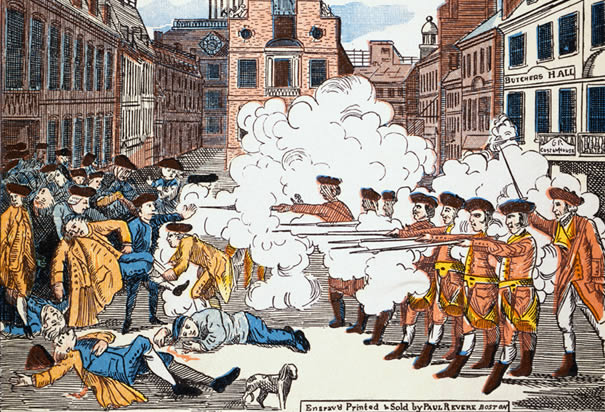
(1)The Boston Massacre
(2)The Boston Tea Party
II. Propaganda and Class
A.Propaganda
1.Thomas Paine and Common Sense--perhaps the only author to approach the popularity of Paine’s pamphlet in modern times is J.K. Rowling (Common Sense sold about 150,000 copies in a country of less then 3 million people, including slaves who were kept largely illiterate--the equivalent sale today, with a population of 300 million, would be 15 million copies)—or the 18th century version of a viral video, since tens of thousands of more people read Common Sense than purchased a copy. Paine’s irreverent, vigorous prose captured the mood of the times, and was probably responsible for giving voice to a great deal of dissatisfaction.
B. Class conflict
1.Worcester County Mass.--farmers closed down the county court system to prevent creditors from using the courts to collect debts; this same action after the victory over the British provoked a different action from the men known to us as the Founding Fathers.
2.Hudson Valley New York--small farmers at this location decided to support the loyalist side, because of the obscene rents they had to pay to Patriot Patroon landholders.
3.The Revolution and Slavery--the rhetoric of freedom and rights resonated with many slaves--and many whites in the northern colonies, who began to question the morality of holding other humans in bondage
a)Many slaves in the north fought for their freedom--and the freedom of whites--in the militias and in the Continental navy.
b)In the colonies of the south, on the other hand, many slaves fled their masters in the hope of gaining freedom promised by the British government (Thos. Jefferson’s reaction to this was excised from the final edition of the Declaration of Independence.
I)Puritanism – a movement for religious reform; the purpose was to reform the Church of England from the dangers of “Romanism;” Puritans called for a more radical cleansing of the Church of England from the remaining Catholic elements (vestments, sacraments, etc.), and for this they became known, derisively, as Puritans and as purifying radicals.
A)Religious movement
B)Political and social movement – response to many long-range changes that had been occurring in English society, as that society was changing from a feudal society to one we think of as more modern.
1)Sought to overturn established church
2)Growth of cities – as enclosure became more prevalent, the growth of urban populations took off (Ex: London grew from a city of 75,000 in 1550 to a population of 325,000 in 1650)
3)Enclosure of the land – created a large body of people no longer tied to the land, or who were able to gain sustenance from it. This shift in population also caused societal unrest, as a large group of “masterless” people (previously, peasants who were tied to the land had been answerable to the lord of the manor—as they were forced to move off the land, this relationship ended) moved into cities, where they had to engage in a variety of pursuits (some of which we can classify as “criminal”) to eke out a living.
4)Increase on trade – trade became more important during this time period, which increased the exchange of goods—and ideas.
All of this contributed to the rise of a capitalist society, in which individuals had more autonomy. Peasants were uprooted from the land, which provided the capitalists with the labor that they needed to operate their factories and ships (in England)—but this also led to an increase in vagabondage and crime, particularly in the growing urban areas as people moved into cities.
C)Medieval web of responsibility
1)Reciprocal relationships – although the medieval lord of the manor demanded labor and other compensation from his serfs or tenants, he was also obligated to certain responsibilities towards theses people, like adequate food and shelter. This system depended upon reciprocity between the classes.
2)Emerging capitalist system – created instability in English society because capitalism ended these webs of responsibility, allegedly allowing individuals to rise according to their capabilities (although if ones ancestors had been extremely capable, or politically connected, this lack of capability could be overcome by inherited wealth).
D)Puritan reaction – while the Puritans attacked the hierarchical governance of churches (especially the Roman Catholic Church), and emphasized one’s personal relationship with God, they deplored individualism in other areas of life, which they saw as leading to social anarchy. The downfall of Anne Hutchinson, in fact, was due to her claim that God spoke to her directly (although her challenges to the male power structure certainly contributed)
1)Individualism a threat to society – individualism was a threat to the community, to the concept of community in the Puritan world.
2)Work as a service to God – one did not have to occupy a high station in life to serve God (although that became a sign that God certainly favored you), one only had to work hard in whatever one’s position was; each calling was equally worthy in God’s eyes.
(a)This did not create the concept of an egalitarian society; there were still social superiors and inferiors, and the latter were still supposed to defer to the former.
3)God’s “elect” – must not only save themselves, but also must assume the burdens of civil government to reform society at large; those who resisted these reforms had to be coerced and controlled, directed and dominated. Puritans did face harassment in England, particularly in the 1620s under James I. This, combined with the economic opportunity opening in other countries (particularly the Netherlands, which had a more tolerant attitude to any religion other than Catholicism) while England was suffering the effects of an economic depression, led many Puritans to leave England and settling in Leiden, the Netherlands. Nevertheless, the Puritans were driven less by motives of profit during this time then by an ideological commitment to build an English Christian utopia, organized around the idea of community and possessed by the idea that industriousness and self-discipline were indispensable parts of worshipping God.
II)Puritan Migration
A)Unhappiness in Leiden – the Netherlands was truly a tolerant country in regard to religious practice, but because of these younger members of the Puritan flock began to lose their sense of Englishness, which became increasingly important to their elders, who feared that they would be assimilated into Dutch culture.
B)Settlement in the “New World” – to ensure that the Puritan children retained their Englishness, the sect elders decided to pursue establishing and “English” settlement in the new world; the king granted them a charter to settle in “Virginia,” but they intentionally sailed further north to put as much distance between themselves and Jamestown as possible.
1)1620 Landing at Plymouth Rock – the Puritans on the Mayflower sailed into Massachusetts Bay, and scouted out several locations before settling on Plymouth, which was closer to the mainland and presented better prospects for establishing family farms
(a)Other settlements – non-Puritan settlements on Cape Cod, devoted to commercial fishing and allied endeavors, were established soon afterwards
2)1630 Mass Migration – during 1630, eleven ships with nearly 700 people landed in the Massachusetts Bay Colony; between 1630 and 1640 12,000 people migrated to New England. With a healthier climate, and the Puritan propensity to propagate, the colony greatly grew in size over a relatively brief period of time.
(a)The addition of this great number of migrants made the Puritan communities less reliant upon natives, while at the same time the appropriated more land—thereby increasing tensions with native groups.
C)Puritan Covenant – the “Citty on the Hill”
1)Established an authoritarian regime
(a)No diversity of opinion concerning religious belief was tolerated for very long (and since secular and religious life were intricately bound together, questions of a political nature quickly became of a religious nature, and vice versa)
(b)Political representation was limited to those “filled with God’s grace” – that is to say, members of the church
(c)Participants agreed to give up certain individual and political freedoms to accomplish greater goals
D)Religious Dissenters
1)Roger Williams – arrived in Massachusetts Bay in 1631
(a)Preached that Puritans were not pure because they refused to completely break with the Church of England.
(b)Argued that the colonists were intruding on Indian soil and were illegally depriving the natives of their rights.
(c)Challenged Puritan leadership, who banished him from the colony and decreed that he be sent back to England; he escaped with the help of English and Narragansett native friends, and he established a new settlement in Providence, Rhode Island.
2)Anne Hutchinson – arrived in MassBay in 1634
(a)Midwife and healer
(b)Began to criticize sermons and ministers
(c)She gathered a community of dissenter around her; eventually the leaders of the Boston community came to see her as a dangerous influence, and after trapping her into admitting to a theological error, banished her from the colony.
III)Puritan World View – because the Puritans represent to us the western rational people, we have overlooked the fact that they were just as superstitious as the Native Americans have been portrayed to be. The Puritans believed in a pantheon of underworld spirits (devils, demons, imps, and particularly witches—witness the Salem Witch Trials), all of which cause not only spiritual distress but physical ailments as well.
A)Puritan Saints – defined as one who has undergone a Puritan conversion experience, and therefore has become one of God’s elect and assured of a place in heaven. A Saint has also learned to recognize, lament (or fell sorry for), and master one’s sinful natural self.
B)Sinners – defined as all other people who have not undergone the Puritan conversion experience
1)Other English people – unconverted; and living examples of the inversion of goodliness
2)Native Americans – also living examples of the inversion of goodliness; in addition, they were men and women living in a natural state, who had not mastered their sinful nature (in fact, they often seemed to revel in it), and therefore they were considered a danger to the Puritan community.
3)Halfway Covenant – each successive generation of Puritans found it harder and harder to come up with a conversion experience; in order to maintain control of the colony within the Puritan families, the idea of the “Halfway Covenant” was resorted to, where men whose families had been members of the church (Saints) could claim limited political rights in the community.
C)Proselytizing – was never an important part of religious practice of the Puritans, since the elect were in fact selected by God, and they tended not to worry about the conversion of the non-elect, since it would do them no good anyway. Puritans never attempted to convert masses of natives along the lines of the Catholic priests from Spain and France.
IV)Puritans and Natives – the English were beneficiaries of microbes in the Mass Bay Colony even before they landed in the area.
A)1616 Smallpox epidemic – the Atlantic Ocean off Cape Cod has long been a fishing haven, and European fishing fleets were fishing the Northern Banks long before it occurred to anyone to set up a permanent settlement there. In 1616, a smallpox epidemic decimated the native population in the area, which enabled the Puritan colonists to settle lands that had recently been vacated by the deaths.
1)Wampanoag Indians—the native group living closest to the Puritan settlement at Plymouth, was in desperate straits when the Mayflower anchored there. Diseases contracted from their earlier contact with European fishermen off Cape Cod. Fearful of threats from other native peoples in the area, the Wampanoag attempted to make the colonists allies
(a)Squanto—present, but not trusted, in the Wampanoag settlement was an Indian who had earlier been captured by Europeans and taken to the Netherlands and to England. Because the sachem of the Wampanoag did not entirely trust Squanto, he brought along a second translator to ensure that the Wampanoag were not betrayed by Squanto.
(b)First Thanksgiving—it becomes apparent, then, that the Wampanoag were generous with the Puritan settlement to ensure the survival and dependence upon them, in case the need arose to recruit further assistance. First Thanksgiving was a way for Puritan settlement to assert its independence.
B)The Thanksgiving myth – the first winter in the Mass Bay Colony, the natives supplemented the food that the Puritans brought with them. The Puritans repaid this kindness by plundering several underground storage cellars of the natives and carrying off as much of the corn as they could; after this theft the natives minimized contact with the English settlers. The natives did not attack the settlement, however—even after the population at Plymouth diminished to about fifty persons.
C)Military model – was used in Plymouth, despite (or maybe because of) the religious nature of the community.
1)Miles Standish – a non-Puritan, who set up a non-Puritan community at Wessagusset, where he and his band attacked the Massachusetts people who Standish felt had insulted him.
D)Great Puritan Migration – by the time of the great migration of Puritans, natives had experienced nearly a generation of English intrusion into their lives, and that experience had not been a positive one
1)Puritan (and English) Theories of Land Possession – ensured that violence against native peoples won out over any ideas that may have been proglumated about assimilation or peaceful coexistence.
(a)Right of discovery – the supposed right of Christians to dispossess non-Christians of their land
(b)Vacuum dimicilium – a second European theory, which claimed land vacant if there were no permanent buildings on it, or if it were not occupied in a “civilized” manner
(i)Claim helped by the aftereffects of the 1616 epidemic, which in itself suggested to the Puritans that God wanted them to have the Indians’ land.
(ii)This idea held up even after being challenged by Roger Williams.
E)Metacom’s War (King Philip’s War)
1)Pequot War (1637) – culminated in the Mystic River Massacre, where the savagery of the English/Puritans (they surrounded the Pequot village on the Mystic River, burned it to the ground, and clubbed to death or stabbed to death anyone (mainly old men, women, and children, since they were the majority of residents in the village at the time) who tried to escape. The intense savagery of the English/Puritans frightened their erstwhile allies, the Narragansetts, who withdrew from contact with the Puritans as much as possible.
2)New England Confederation – the colonies of Massachusetts, Plymouth, and Connecticut came together (three Puritan colonies) to forge an offensive against the Narragansett (and possibly there heretic allies in Rhode Island).
(a)Narragansetts petition the king for royal protection against the Puritans in 1644—but they declare that they will never submit to being ruled by the Puritans.
(b)Narragansetts do cede land and some goods to pay for mobilization to the Puritans when they felt that they could not win a war, biding their time for a more advantageous opportunity.
3)Native responses
(a)Submission to Puritan domination – proliferation of so-called “praying villages” (the Puritans had responded to the increasing criticism from England that they had made no attempt at converting the natives to Christianity, and began proselytizing among native peoples).
(b)Withdrawal from homeland to areas further west, away from Puritans.
(c)Third Way – choice to stay and fight against the Puritans, and actively resist them.
4)Metacom – was the younger son of Puritan ally Massasoit.
(a)Older brother Wamsutta died mysteriously after meeting with Puritan leaders in Plymouth
(b)Trial and hanging of three Wampanoig men for the alleged murder of John Sassamon, and Christianized native (who was an informer who had apprised the Puritans that the Wampanoig were planning to attack their settlements (early June 1675)
(c)June 25, 1675 – war broke out on the day of a total lunar eclipse, which the natives may have interpreted as a sign of providence.
(i)Series of hit-and-run raids, which the Puritans fail to respond to militarily effectively
(ii)Neighboring native peoples were emboldened to join in an alliance with the Wampanoig
(iii)Native alliance hugely successful—they eventually kill ten percent of the white adult male population, and men become reluctant to be subscripted to fight the natives.
Spring of 1676, the native offensive stalled because of attrition (the war meant the natives were unable to harvest enough food). Many natives retreat further west; the leaders were rounded up and executed, and the women and children were enslaved, and exchanged for African slaves from the West Indies.
V)William Penn’s Colony
A)Pre-Quaker European settlement – a variety of European peoples, Swedes, Finns, Dutch, and English all settled in the area.
1)Dutch – in New Amsterdam (New York) most were interested in trading with natives for animal pelts—particularly beaver, which was to be made into hats—in return for firearms (and other metal goods) and rum.
2)Natives learned European mores – natives, because of their exposure to other Europeans, were familiar with their usual modes of operation
B)Society of Friends (Quakers) – began during the English Civil War, in reaction to the factional sect dispute there. Friends emphasized pacificism (refusal to fight in wars), and refused to swear oaths; they had no clergy, and worshipped at meetings, held in meeting houses. Religious doctrines determined by members reaching a consensus, which all then agree to abide by; reliance upon community pressure, and community solidarity, to get members of the community to behave in acceptable ways.
1)Hostility towards Quakers – their lack of aggression, and radical religious views others found threatening. Quakers were suppressed and persecuted in England, which made them eager to migrate—where they continued to be persecuted, in many instances.
2)William Penn – was a wealthy English merchant who converted to Quakerism; he was friends with Charles II, and the king borrowed a substantial sum of money from Penn, which he had difficulty paying back; Penn agreed to accept a huge tract of land in North America as payment on this debt (1681)
(a)Insisted on paying natives for their land – despite receiving title to the land in payment of a debt, Penn met with the native residents in what became Pennsylvania to negotiate the sale of the land by the natives to him.
(b)First Quakers were primarily farmers, which meant that the acquisition of adequate amounts of land was a first priority.
(c)Middling Classes – most Quakers came from the emerging middle classes in England, and were just as eager as the Puritans (as will become evident later) to profit from business endeavors; however, religious principles emphasizing the belief that people of different cultures could live together in peace and harmony tempered that.
(d)Communication of peaceful intentions – in the Letter to the Delawares Penn communicated that “the king of the Country where I live hath given unto me a great Province therein, but I desire to enjoy it with your Love and Consent, that we may always live together and Neighbors and friends …”
3)Penn’s arrival (1682) – the year after receiving the gift from Charles II, men arrived in “his” colony, and began negotiations with the native Delaware, as well as learning their language.
(a)Differing concepts of sale – the Delaware’s concept of the transaction was more that of granting a lease (in modern terms), a lease that could be ended at the whim of the owners, which was the Delaware, collectively. Penn acquiesced on this point, which helped keep thing peaceful during the bargaining sessions.
(b)Lack of extensive trade with the natives – the European settlers in Pennsylvania did not trade extensively with the Delaware or other native groups in the area, and the Delaware may have been willing to negotiate this agreement with Penn to encourage more trade; most of the intercultural trade at this time was funneled through Albany and New York City.
(c)Fewer natives in Pennsylvania – were present in Pennsylvania at the time of the Quaker settlement; the Susquehannocks, former rivals of the Delaware who had been trading partners with the Dutch had been weakened and depleted during Bacon’s Rebellion (the ranged across Pennsylvania and into Virginia) before Penn’s arrival; this made the Delaware more willing to accommodate the influx of Quakers, since the Delaware knew there was more land available to the west (the area the Susquehannocks had largely vacated).
4)Penn suffers incapacitating stroke (1712) – Penn suffered a series of strokes he suffered beginning in 1712, and after this period he never again visited his colony.
(a)As long as William Penn (the senior) was the guiding force in Pennsylvania, relations with the natives remained amicable; after his death, those relations quickly deteriorated.
C)Pennsylvania after Penn’s death
1)Other Protestant sects – sects like the Swiss Mennonite, the Scotch-Irish Presbyterians, and German Pietists all sought the freedom of religious conscience, for themselves, but were also fleeing economic difficulties in their homeland—they wanted to worship God in their own way and obtain cheap land. But they were not prepared to accommodate themselves to the natives whose land they obtained.
2)Quaker policy of toleration – meant that they eventually lost control of the government, as other religious groups became more numerous.
(a)James Logan fraud – Logan, Pennsylvania’s largest land speculator, produced an alleged copy of a document signed by Delaware representatives granting him a huge tract of land. Despite not being able to produce the original, nor the fact that there was no other documentation, nor the fact that nowhere in the Delaware oral tradition—usually a reliable source in land transactions—was there any record of this, the government sided with Logan.
(b)“Walking Purchase” (1737) – two sons of William Penn negotiated a further purchase from the Delaware—the amount of land that lay between the Delaware and Lehigh Rivers equal to the amount a man could walk in a day and a half. After negotiating these terms, the Penns’ had the trail blazed (removing many obstacles and underbrush), and then hired three specially trained men who ran in a relay and managed to cover more than eighty miles in the allotted period—much more than the Delaware believed they had bargained for.
VI)Establishment of New York
A)Dutch East India Company – one of the earliest capitalist enterprises; investors from various Dutch cities (but principally Amsterdam) decided how much to invest, and what the desirable return on that investment would be. This became a model for European colonies in the rest of the world—European governments chartered colonies in areas in North America and Asia to encourage private investors to underwrite colonization, while making laws which decreed that the wealth created in these colonies would enrich the metropole (home country).
B)Dutch West India Company – was set up on the Dutch East India model to exploit resources and labor in the western hemisphere.
1)By 1628, the Company was trading for as many as 8,000 furs a year with native Americans.
(a)Effect upon native cultures – the desirability of European finished goods (principally metal goods like knives, metal used for arrowheads, pots—and firearms) led natives to change long-standing patterns of subsistence hunting and trapping to hunting and trapping to provide furs for trade with the Dutch (and later the French and the English). As the supply of animals diminished in an area, native groups were forced to move into new areas, which caused conflict with native groups already residing there.
(b)Dutch settlements remained small and relatively peaceful; the Dutch never had more than 10,000 people settled in North America, and were therefore easily overrun when the English became interested in the areas they controlled.
2)Introduction of slavery – because of the lucrativeness of the slave trade, the Dutch were more than eager to seized control of the slave trade.
(a)Portuguese and Dutch – battle for slave trade was a part of a larger battle between these two countries, initially, over supremacy of trade in both the East Indies and the West Indies. The Dutch were successful in both areas, gaining both the spice trade and the slave trade. By 1630, the Dutch controlled the traffic in both sugar and slaves to and from Brazil. To encourage more traffic in both commodities, the Dutch instructed English plantation owners in the Caribbean on sugar cane cultivation, and created new customers for the slaves Dutch ships carried from Africa.
3)Slave and sugar profits – the slave/sugar nexus was so profitable, that it drew the attention of English merchants for control of that trade, and thus touched off a series of international wars (early versions of “world wars,” if you will) for control of that trade.
VII)South Carolina
A)Atlantic World connections—South Carolina (or simply, the Carolinas) were closely connected to the SugarIslands trade; the early English settlers were related to plantation-owning families in Barbados.
1)Grain belt—the Carolinas initially supplied foodstuffs for the plantations in the SugarIslands; with the introduction of larger numbers of slaves to the colony with expertise in growing rice, production shifted to that grain.
2)Sea Island cotton—although when we think of slavery intimately linked with the growing of cotton, only long-staple cotton was worth growing before the invention of the cotton gin, and that cotton would only grow on the Sea Islands of South Carolina and Georgia
B)Wealth creation
1)Most of the wealth in the Carolinas was concentrated among the planter elite; these elite had the connections to develop trade relationships with plantation owners in the Caribbean.
2)Charleston—from about 1700 to the opening of the Erie Canal in 1815, Charleston is probably the wealthiest city in the country. Charleston was home to the planter elite of South Carolina, who generally left the day-to-day management of the plantation to overseers, while they enjoyed the fruits of their wealth in the city until summer, when they adjourned to Newport, Rhode Island (one of the reasons that Rhode Island had one of the largest populations of slaves in the north)
VIII)Georgia
A)The Prison Colony—Georgia was founded by James Oglethorpe in 1733 as a refuge for inmates sent from English debtor’s prisons. In England at this time, persons unable to pay their debts were placed in prison until their families were able to raise enough money to repay the debt. After a friend contracted smallpox and died while in prison, Oglethorpe came to believe this policy wrong, and using his influence in Parliament—as well as his own money—Oglethorpe was able to secure a settlement near the mouth of the Savannah River.
B)Oglethorpe and slavery—Oglethorpe disliked slavery, believing that it undercut individual industriousness, and forbade its establishment in “his” colony (he also forbade the sale of rum, for many of the same reasons)—although officially Oglethorpe was never anything more than a trustee of the colony.
C)The Military Buffer—for England and the Carolinas, Georgia was to be a buffer between the wealth of Carolina and the threat posed by the Spanish in Florida. This role as military buffer created difficulties for early white settlers in the colony, who were constantly under threat of invasion. During the Battle of Jenkins’ Ear (War of Austrian Succession in Europe), Oglethorpe’s leadership of a band of Georgia militia led to his acclimation in England. When Oglethorpe returned to England, however, Georgians turned to rum and slaves
IX)Wars for Empire and Native Strategies for survival, 1675-1763
A)European struggle for supremacy – France, Spain, the Netherlands, and England engaged in almost continuous warfare during this time period.
B)Glorious Revolution (1688) – William of Orange and his English wife Mary (sister of the deposed monarch James II, who was Catholic) were invited to sit on the English throne by Parliament
C)King William’s War (1689-1687) – William agreed to ascend to the throne because of his concern over the growing power of the French monarch (Louis XIV), and the threat he posed in dominating Europe (especially the threat posed to the tiny country of the Netherlands)
1)Bank of England (1694) – resulted from William’s concern over stable financing for the military (before this time period, military financing was completely reliant on how much money the king could obtain from Parliament). The Bank of England had been initially financed out of the profits from the sugar plantations of the Caribbean—most of the directors of the bank were either former plantation owners, or members of families connected with these plantation owners.
(a)Financing wars and colonial expansion – the king sold bonds (defined as a promise to pay a certain amount of money at a specified time in the future), which the Bank of England bought at a discounted rate (that is, at a cheaper price than was available to the general public). The Bank was then able to resell these bonds at the higher rate, and pocket the difference—a guarantee of a profit. This allowed the king to regularize the national debt, and allowed him, and his successors, to finance a number of wars and colonial expansion over the next century.
2)The War in the North American Colonies – the attempt to drive the French from the North American continent; attacks on the French stronghold were disastrous, initially. The English entice several native peoples to ally with them against the French; however, the financial aid from the English never really extended to the colonies in North America, and the colonists themselves are slow—or refuse—to come to the aid of their fellow colonists.
(a)The male population, particularly the underclass, or “lower sort” as they were then referred to, were impressed (kind of like being drafted) into service, and suffered most severely.
(i)20% of the adult male population in Boston served in the British army during King William’s War, and as many as 25% of those who served were killed; in addition, the city had to pay for the army it raised.
D)Queen Anne’s War (War of the Spanish Secession, 1702-1713) – Anne was Mary’s sister (William and Mary had not produced a male heir to the throne); this war in Europe was fought over who would be allowed to ascend to the throne in Spain.
1)Iroquois Treaty (1701) – the Iroquois signed treaties with both the French and the English, which they then used to stay out of the dispute between the two European powers.
2)Burden of War in Boston
(a)Manpower – the loss of life created burdens upon the families of the men who were impressed, which tended to increase the rate of impoverishment, and the financial burden that the city owed to these people.
(b)Higher taxes – to pay for the army the city put into the field; recruiters counted upon plunder to pay this back, but the general lack of decisive victories did not lend itself to this.
(c)Economic downturn – the culminative effect of the war was dehabilitating on many in the city, which to this point had been the most prosperous in North America.
(i)The main beneficiaries of the war were those involved in shipping and shipbuilding; both artisans involved in construction of ships (who could avoid military service), and those who owned ships (particularly if they had the financial wherewithal to be able to lose a ship or two), since fees to transport goods and men skyrocketed during this time period.
E)King George’s War (War of the Austrian Succession, 1740s) – yet another invited monarch, this time George Windsor from Hanover, who was another cousin of James II. War was again fought against France to control the continental ambitions of its king (Louis XV)
1)War profiteering – not all people suffered during these wars, of course
2)Self-interest v. Commonweal – commonweal is defined as the good of the greatest number; today it is a synonym for a political body (commonwealth). In this time period, the term meant for the good of all in society, which took the form of regulation the price of bread and other essential to daily life
(a)Andrew Belcher – hoarded grain during Queen Anne’s War, when a crowd of Bostonians discovered this treachery they liberated the grain until Belcher agreed to sell it to a local mill at the usual price
(b)Selling to the enemy – colonial merchants in New York and Philadelphia during King George’s War sold grain and other goods to French and Spanish plantation owners in the Caribbean, two countries England was at war with